
Where Research & Development Meets Business
How can a company identify what it truly needs before selecting a research method? Olga Zajączkowska Zajączkowska, Chief Product & Innovation Officer at Paged Plywood and Member of the Management Board of Paged LabTech Tech, talks about opening the R&D center to the market, collaborating with customers, and why a good project often starts with a thoughtful conversation.

You joined the Management Board of Paged LabTech in January 2026. With what mission?
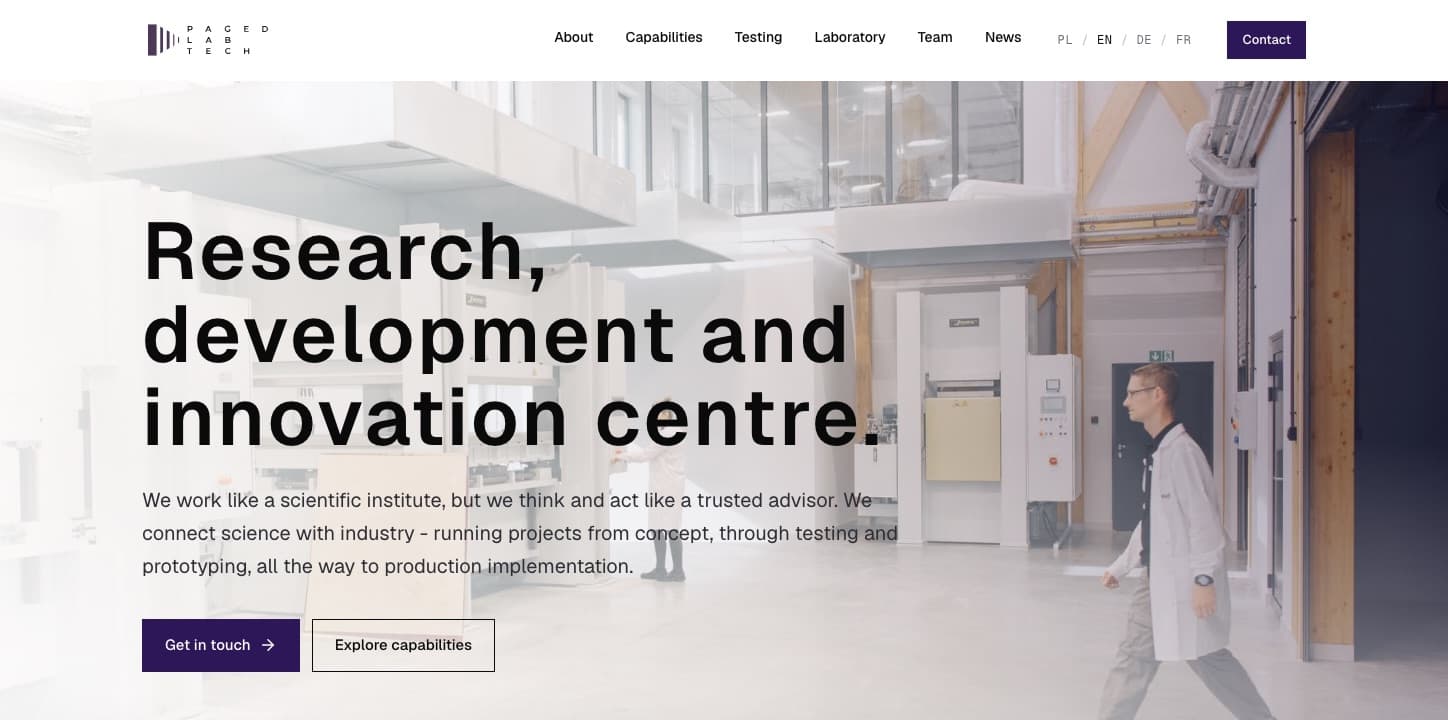
I joined with a clearly defined goal - to strengthen the strategic role of Paged LabTech in the development of innovation, new technologies and products, as well as to open the center more broadly to the needs of industry. LabTech already had a built team and developed research competencies. It was important to me to connect this potential even more strongly with product development, implementation processes and the commercialization of new solutions. This is a natural extension of my responsibility for product development and innovation at Paged Plywood. At the same time, we organized communication, created a website and began consistently building the recognition of our center as a technology partner also for companies outside the Paged Group. Paged LabTech is not only a research facility, but above all a place where knowledge, technology and experience translate into concrete solutions for business.
You talk about bringing science and the market together. What should such a conversation look like?
We start with what the customer wants to achieve or what is not working according to their expectations. It may concern a material that wears out too quickly, a change in surface color, or a product intended to operate in more demanding conditions. At such a moment, a list of devices and methods tells them very little. Only when we properly understand the application and the expected result do the team's knowledge and the laboratory's capabilities become useful to them. This requires from us the ability to translate technical issues into decisions that a company can make.
Where do the ideas for new R&D projects come from?
From very different conversations. A customer asks whether something can be done differently; a salesperson hears about a recurring need; a technologist or someone from production notices a limitation of the current solution. Sometimes the starting point is simply the question: “Why is this happening?” We also observe regulations and technological changes. The most interesting ideas are born when we connect these signals instead of looking at each of them separately.
What topics do companies most often bring to Paged LabTech today?
They ask about the durability and resistance of materials, flammability, emissions, ageing, color changes, or confirmation of required parameters. They often already have test results, but they do not know how to interpret them in the context of the product and what to do next. Then we can help interpret the data, determine the cause of the material's undesirable behavior and plan the next steps. Sometimes this means one well-selected test, and sometimes longer cooperation on a product or an entire system.
What happens during the first conversation before the topic reaches the research team?
We ask what the product is made of, where it will be used, under what conditions it is supposed to work and what has already been checked. The customer's expectations and the requirements that the material will have to meet are also important. Only with such a picture can we sensibly plan the research. It happens that what is visible in the finished product has its source in the production process or in the way it is used. If we start with the symptom itself, it is easy to examine the wrong thing. This preliminary conversation therefore saves time and allows the team to focus its work on the questions that will really bring us closer to the answer.
Does Paged LabTech primarily target the wood industry?
This is our important base of experience, but the application of these competencies is much broader. We talk with companies from construction, prefabrication, transport, furniture manufacturing and the materials industry. Knowledge about bonding, coatings, resistance to environmental conditions or ageing is useful in many sectors. Therefore, during a meeting I am more interested in how the material is supposed to behave and what the company is trying to deal with than in the name of the industry itself.
To what extent must R&D anticipate customer needs?
If we focus exclusively on what someone is asking about today, we will notice some changes too late. Therefore, we look at the direction of regulations, new technologies and requirements concerning safety and the impact of products on the environment. In construction or transport, the road from an idea to a finished application can be long. It is worth starting work earlier, when it is still possible to calmly check different possibilities, and not only when a new requirement becomes urgent to implement.
Do regulations, for example regarding formaldehyde emissions or fire safety, help drive innovation?
They certainly influence the direction of work. For a company, a new requirement is sometimes first a difficulty, but for an R&D team it can be an impulse to develop a better material or change a technology. However, there must be time for trials, evaluation of results and implementation. If work starts only on the day the regulations come into force, there is usually not enough time. Our task is to notice such changes early enough and talk with customers about their possible effects.
Paged LabTech obtained PCA accreditation. What does that change from the customer's point of view?
It provides independent confirmation of the laboratory's competencies within the scope covered by the accreditation. This is an important argument, especially when a test result is to be used for making further decisions. Accreditation itself, however, will not replace good cooperation. The customer needs a reliable result, but equally important for them is whether we can explain it, relate it to a specific application and jointly determine what the next step should be.
How do you show companies that they can come to you even if they do not yet know which test to commission?
The best way is to show specific stories: with what question the company came, what we learned along the way and what we managed to change. Our technological and research facilities give us broad possibilities, but the key is the skillful use of these resources to solve specific industrial challenges. It is easier to start a conversation from the fact that a material changes color, loses properties or does not pass a test, although it is not known why. You do not need to have a ready specification. You can come with an observation and jointly determine what is worth finding out.
What role do direct meetings at trade fairs and conferences play?
They are very valuable to me. This is an excellent opportunity for direct conversations with representatives of different industries, learning about their needs, technological challenges and directions of development. Such meetings make it possible to better understand the context that is often missing from a formal inquiry: where a given need came from, what solutions the company has already tested and what limitations it is facing. More than one project idea appears precisely when, after such a meeting, we return to the team and consider whether the issue can be approached differently.
What has surprised you most in conversations with industry?
My experience shows that one of the biggest challenges today is not access itself to technology, equipment or research results, but the ability to translate scientific knowledge into solutions that have real business value. During years of work in the area of research, product development and commercialization, I have repeatedly observed that even the most promising technology will not achieve success if we do not take into account production realities, market expectations, implementation costs or possibilities for scaling. That is why an interdisciplinary approach is so important to me - combining technological competencies, knowledge of materials and processes with an understanding of business needs. It is precisely in this that I see the greatest value of a modern R&D center: not only in delivering research results, but above all in the ability to translate them into concrete decisions and solutions.
And what would you like to hear in a few years from someone who knows Paged LabTech?
I would like to hear: “When we face a technological challenge, we know who to turn to.” It is important to me that Paged LabTech is perceived as a trusted technology partner that combines scientific knowledge with industrial practice and understands business needs. If solutions arise from this cooperation that truly find application in practice, I will consider that we have done our work well.
Thank you very much for the interview!