
Varnish on wood and plywood - protection or a potential source of complaints?
Varnishing wood and plywood is often associated primarily with aesthetics: an attractive colour, a gloss finish, a smooth surface and easier cleaning. Is this always the case?
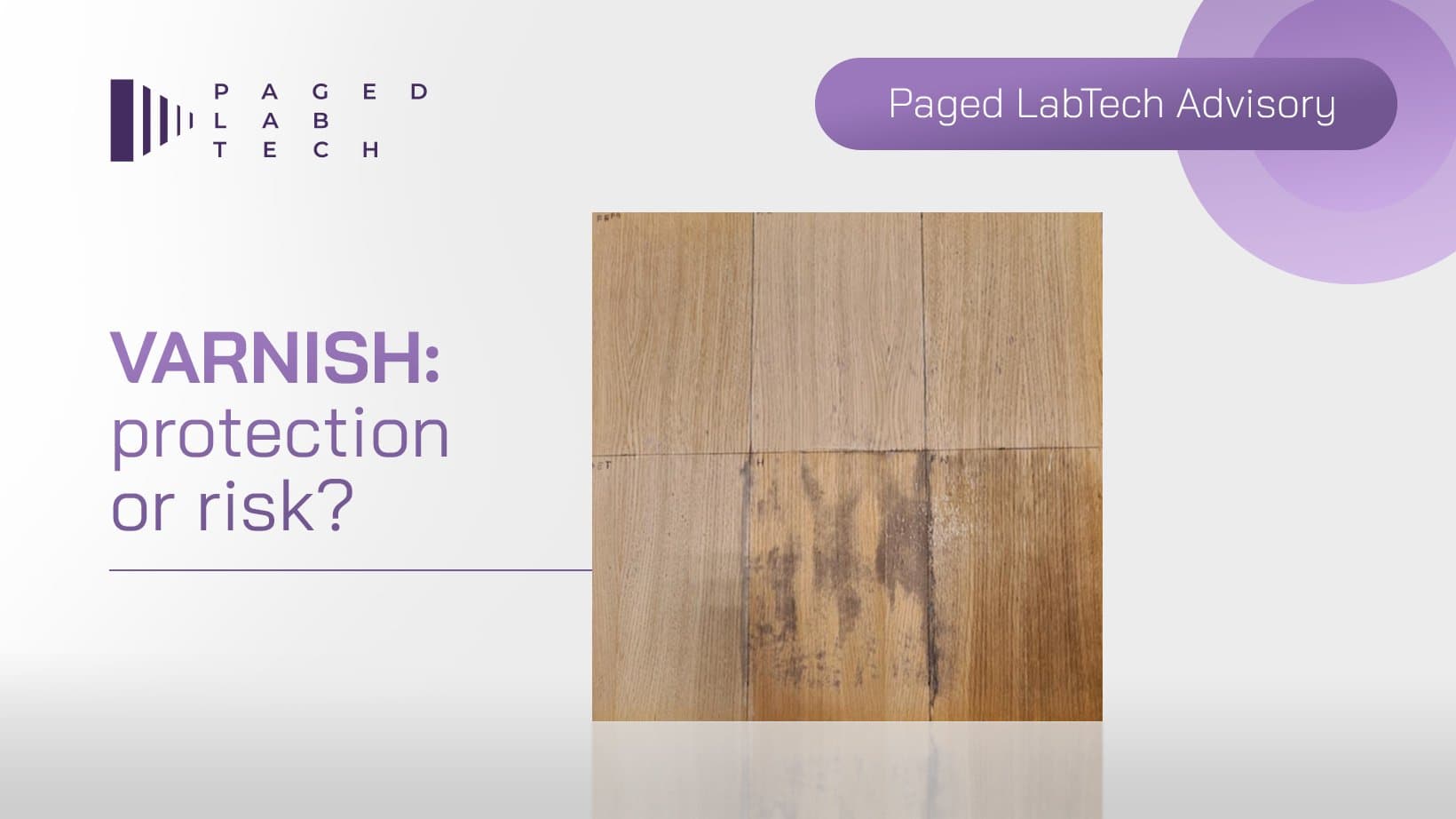
Wood and plywood are natural materials that expand and contract, absorb and release moisture. They also contain tannins, extracts, natural pigments and other chemical compounds that may react with the coating.

My experience of over 20 years in protecting wood and plywood suggests that the greatest risk lies not in how the surface looks on the day of application, but in how the entire system will behave over time.
Examples of complaints that may arise after varnishing
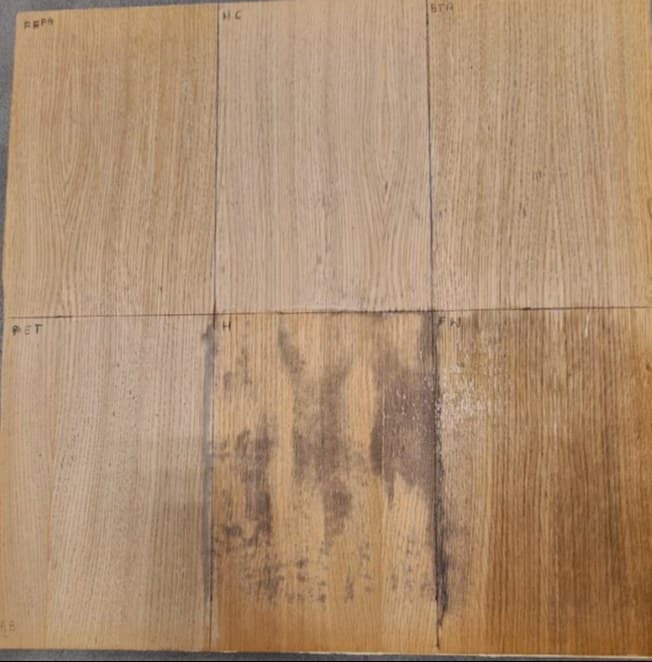
Dark stains on wood
Grey, black or blue-black discolouration may result from a reaction between the tannins present in the wood and iron. Sources of iron include not only nails, but also metallic dust, tools or components of the finishing system. Oak and oak veneers, in particular, contain high levels of tannins and may therefore react with metals, components of varnishes, wood preservatives or cleaning agents. This results in dark spots, streaks or stains beneath the finish. It is important to prepare the surface thoroughly, neutralise the tannins, use a suitable primer and a tried-and-tested topcoat.
Yellow stains on beech
Beech can be very demanding. With light-coloured varnishes, water-based systems or transparent finishes, the absence of a suitable primer or blocker may, over time, lead to the appearance of yellow, brown or irregular stains. Immediately after varnishing, the surface may look perfect, but the problem only becomes apparent when exposed to light, moisture or temperature changes.
Bubbles, cracks and flaking of the finish
Wood and plywood change dimensions when exposed to moisture. The varnish must be able to ‘keep up’ with this. If it is too rigid, too impermeable or has poor adhesion, blisters, micro-cracks, flaking or delamination may occur. In plywood, uneven protection of the sides and edges can lead to stress, warping, swelling and even weakening of the inter-layer bonds.
Yellowing, dulling and loss of visual appeal
A coating that initially looks very good may, after exposure to UV light, lose its gloss, change colour, become matt or start to crack. Transparent systems, where the aim is to showcase the natural grain of the wood, are particularly vulnerable. The more natural the effect, the greater the importance of the coating’s resistance to light, moisture and ageing.
Why is ageing testing necessary?
A standard assessment after varnishing only shows the initial condition: colour, gloss, hardness, adhesion and surface appearance. However, it does not show what will happen over time.
Ageing tests allow us to simulate the conditions that arise gradually in real-world use: UV radiation, moisture condensation, water spray, temperature changes and the cyclical swelling and shrinkage of the wood.
This makes it possible to verify more quickly whether a coating system is safe, stable and compatible with a specific timber species or type of plywood. This is not an additional test. It is a practical tool for minimising complaints.
Conclusion
Varnish, wood preservative, primer and the entire protective system can significantly increase the durability of timber and plywood. But only if they are well-suited to the substrate and conditions of use.
An incorrectly selected system can have exactly the opposite effect: stains, discolouration, loss of adhesion, cracking, flaking or a reduction in the product’s durability.
Paged LabTech possesses the expertise and appropriate research facilities to verify such phenomena: from assessing changes in colour and adhesion, through the ageing resistance of coatings, to analysing the risk of discolouration, degradation and incompatibility between the protective system and the timber or plywood.
Check out the QUV testing method or the full offer at Pagd LabTech portal. Exposure of wood coatings to artificial weathering - QUV
Author: Ewelina Depczyńska, R&D Director of Paged Group and CEO of Paged LabTech
Ewelina Depczyńska, PhD Eng. heads Paged LabTech and she is responsible for technology strategy, the development of research competences and the effective translation of innovation into scalable industrial implementations. Ewelina holds a doctorate in technical sciences in the field of wood technology. She combines an interdisciplinary education in chemistry, materials science and engineering (Uniwersytet Przyrodniczy w Poznaniu, Politechnika Wrocławska, Uniwersytet Jagielloński, postgraduate studies at SGGW) with over 20 years of experience in R&D management in sectors related to wood, industrial chemistry and composite materials.
Since 2019 she has been building an integrated product development model within the PAGED Group - from basic and industrial research, through laboratory and semi-industrial validation, to production implementation and certification compliant with EU market requirements.
Under her leadership, Paged LabTech has delivered strategic projects in fire resistance, low emissions and material durability (including Flame, FireExpert and FreePly), strengthening the position of the PAGED Group as a technology leader in the specialist plywood segment. Her approach is founded on scientific rigour, partnership with research institutions and the consistent building of competitive advantage through innovation aligned with European environmental and construction regulations.