
Test method 05
Determination of the modulus of elasticity in bending and bending strength
What does this mean for you?
You can precisely measure how stiff and how strong in bending a material is and compare it with other solutions.

- Standard
- PN-EN 310
- Material
- wood-based panels over 3 mm
- Specimen
- width 50 mm, length 20 × t + 50 mm
- Test duration
- approx. 30 minutes for 12 specimens
Method description
The test makes it possible to determine two key mechanical properties of wood-based panels: bending strength and modulus of elasticity in bending.
The specimen, supported at two points, is loaded at mid-length – this is 3-point bending. The measurement is performed using a universal testing machine for static testing.
Before testing, the specimens are conditioned to constant mass at 20°C / 65% RH. During the test, the maximum force, bending strength and modulus of elasticity are determined.
The test is destructive – the specimen should fail within 60 ± 30 s.
Business impact: better selection of material for a specific application, a lower risk of structural problems and faster development of new products.
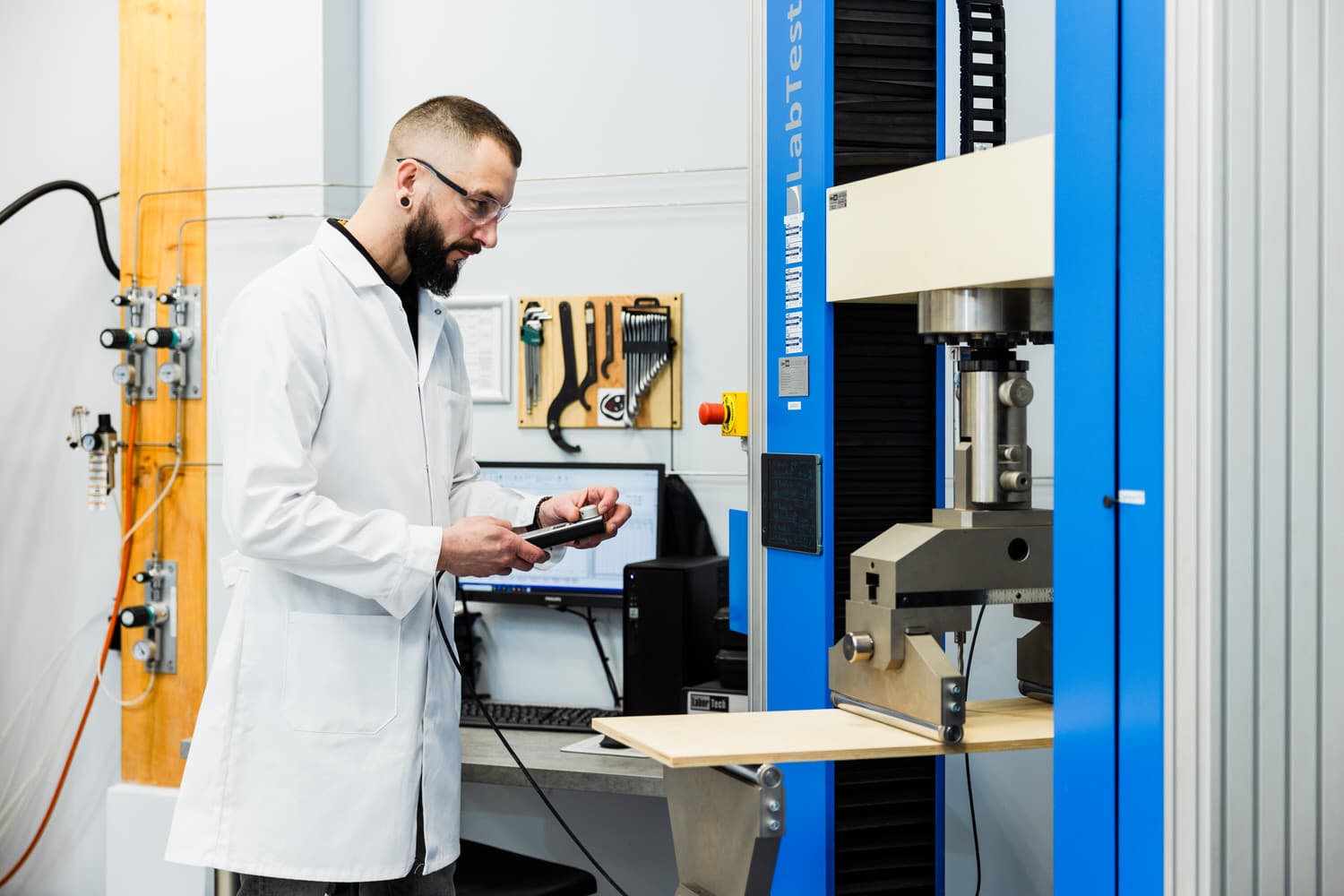
See how the test is carried out
Test specimens
The method is intended for wood-based panels with a nominal thickness of more than 3 mm.
The dimensions depend on the nominal thickness t:
- length: l = 20 × t + 50 mm
- width: b = 50 ± 1 mm
The specimen length should range from 150 to 1050 mm.
The approximate test time for a set of 12 specimens is about 30 minutes.
Benefit: within a short time you can obtain data for a direct comparison of the mechanical properties of different materials, using only a small amount of material.
Test standard
The test is performed in accordance with PN-EN 310.
Benefit: mechanical parameters are determined according to a standardised procedure, which makes it possible to control and compare materials reliably.
Applications of the test method
Wood industry and manufacturers of wood-based panels
Control of the mechanical properties of plywood, particleboard including OSB and other wood-based panels, and use of the results in Factory Production Control (FPC).
Construction
Comparison of the mechanical properties of panels intended for building and structural applications.
Furniture industry
Assessment of the stiffness and strength of materials used in furniture structures and furnishing elements.
Transport
Comparison of panel materials intended for vehicle fit-out elements in which mechanical properties are important.
R&D and material manufacturers
Validation of new panel constructions, comparison of technological variants and assessment of the impact of product changes on its mechanical properties.
The test makes it possible to:
- determine bending strength
- determine the modulus of elasticity
- compare the stiffness of different materials
- assess the impact of technological changes on mechanical parameters
- support Factory Production Control
- carry out R&D work and material validation
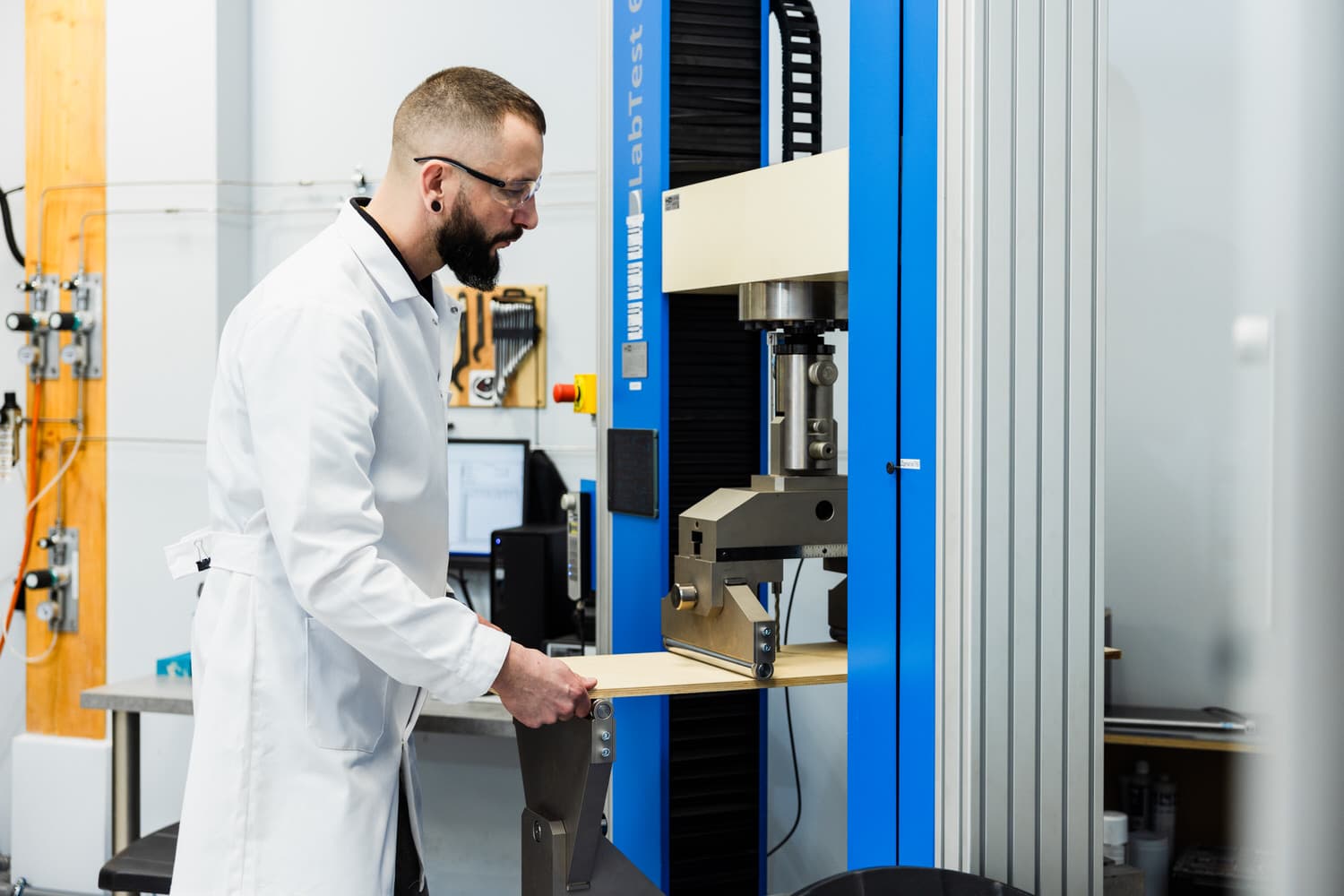
Instead of assuming that a material is strong enough, you can measure and compare its properties.
Contact
Let's talk about your research challenge.
Describe the scope; we will select the method, plan the test and confirm the terms of cooperation.