Test method 04
Determination of formaldehyde emission by the gas analysis method
What does this mean for you?
Within 2–3 days you can obtain a result that allows you to quickly assess the level of formaldehyde emission from a material.
- Standard
- PN-EN ISO 12460-3
- Chamber temperature
- 60 ± 0.5°C
- Specimens
- 3 × 400 × 50 mm + 4 × 50 × 50 mm
- Test duration
- 2–3 days
Method description
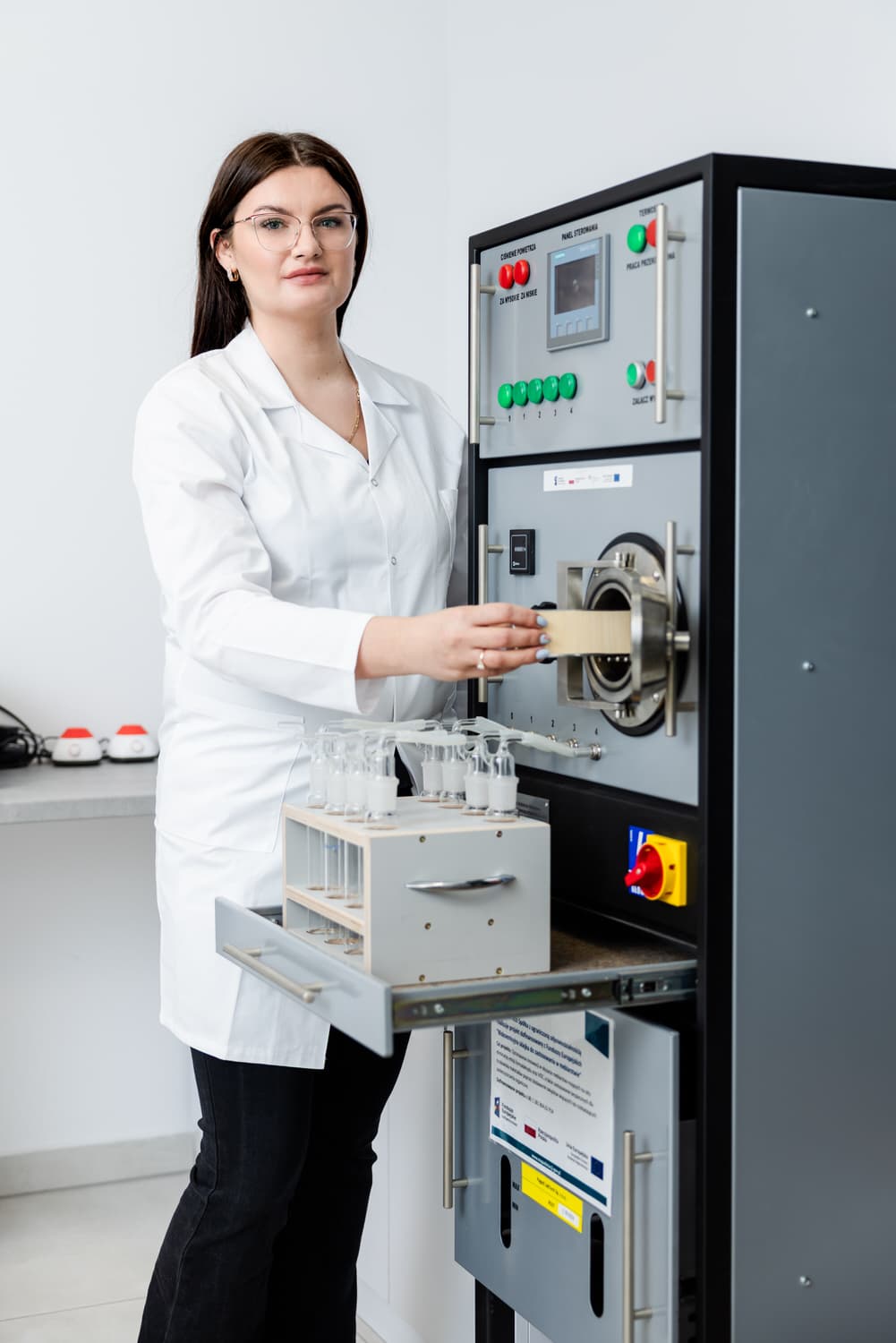
Gas analysis is an accelerated method for determining formaldehyde emission.
The specimen is placed in a test chamber heated to 60 ± 0.5°C. The air flowing through the chamber becomes saturated with formaldehyde emitted from the material and is then directed to glass gas washing bottles.
The formaldehyde is absorbed in a solution and reacts with acetylacetone and ammonium acetate. The resulting colouration makes it possible to determine its concentration – the greater the colour intensity, the higher the formaldehyde concentration.
Business impact: faster material qualification, a shorter product development process and the possibility of eliminating solutions with an undesirable emission level at an earlier stage.
See how the test is carried out
Test specimens
The test requires:
- 3 test specimens: 400 ± 1 mm × 50 ± 1 mm
- 4 specimens of 50 × 50 mm for determining moisture content
Test duration: 2–3 days.
Benefit: the short determination time makes it possible to compare different materials, technologies or production batches quickly.
Test standard
The test is performed in accordance with PN-EN ISO 12460-3.
Benefit: the rapid measurement is carried out according to a standardised method, which makes it possible to obtain reliable and comparable results.
Applications of the test method
Construction
Assessment of formaldehyde emission from wood-based materials intended for use in buildings.
Furniture industry
Control and comparison of the emission of materials used in furniture production.
Interior furnishings and finishing
Testing of materials intended for fit-outs and furnishing elements of rooms.
Toy industry and children's furniture
Assessment of materials intended for the production of toys and furniture for children.
Transport
Testing of materials used in the fit-out and interior finishing of vehicles.
The test makes it possible to:
- determine formaldehyde emission rapidly
- compare different materials and technologies
- monitor the impact of changes in the production process on emission
- test different batches of material
- support the material qualification process
- support Factory Production Control
Within just 2–3 days you receive data that enable you to make informed decisions about the material.
Contact
Let's talk about your research challenge.
Describe the scope; we will select the method, plan the test and confirm the terms of cooperation.